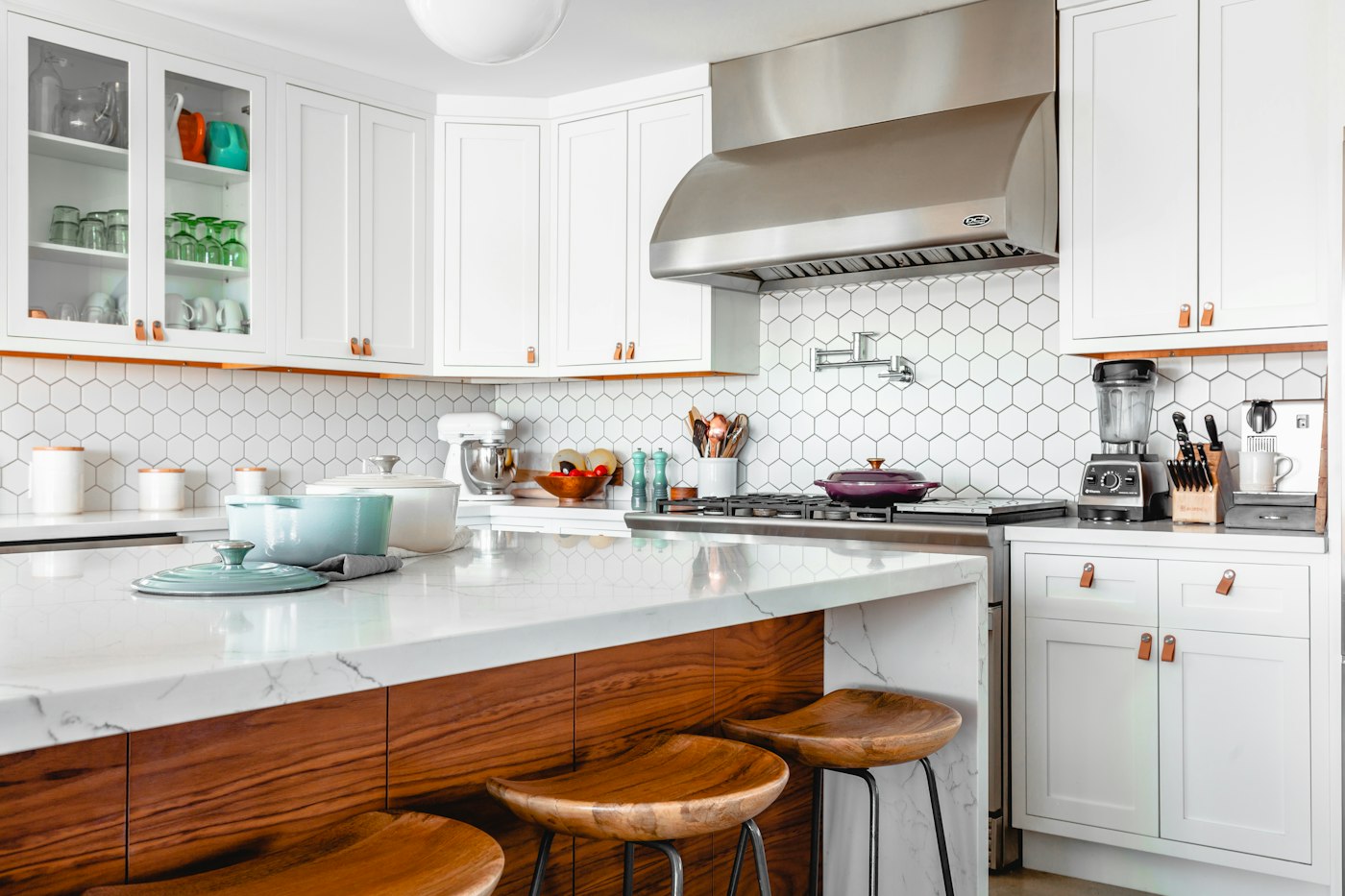
Kitchens are asked to do more than any other room. They are workshop, office, stage and gathering place, often before nine in the morning. The temptation is to give every function its own zone, its own cabinet and its own appliance. The result is a room that works hard and says nothing.
A statement kitchen takes the opposite approach. It chooses one idea — a stone, a colour, a line of cabinetry, a view — and lets everything else support it.
One idea, held quietly
The statement does not have to be loud. In one recent project it was a four-metre island cut from a single slab of pale limestone. In another it was a wall of oak cabinetry with no handles and no upper cupboards. In a third it was simply the decision to keep every surface white so the garden became the only colour in the room.
What matters is that the idea is structural, not decorative. A statement tap or a patterned splashback can be lovely, but it will not carry a room. The gesture has to be big enough to be felt from the doorway.

Plan the work triangle, then forget it
Ergonomics come first and should be invisible afterwards. Sink, hob and fridge should sit within a comfortable walk of one another, with worktop between each. Aisles of 1.1–1.3 metres are generous enough for two cooks and tight enough to be efficient.
Once the triangle works, stop optimising. Endless small efficiencies produce a kitchen that feels like a laboratory. Leave some empty worktop. Leave one cabinet for things that do not have a category yet.
Decisions that make the difference
- Invest in the island. It is the hardest-working surface and the one guests stand around. Make it deeper than you think you need.
- Choose handles last. Let the cabinetry proportions set the scale; a slim brass pull often beats a statement knob.
- Hide the appliances you do not love. Integrated dishwashers and panel-ready fridges buy visual calm.
- Light in layers. Task lighting under wall cabinets, pendants over the island, and a dimmable ambient layer for the evening.
- Leave one open shelf. A place for the bowls you actually use keeps the room from feeling sealed.
Materials that can take it
A kitchen is the one room where patina is guaranteed. Honed stone, solid timber, unlacquered brass, glazed tile and painted timber all improve with use; high-gloss laminate does not. Choose surfaces you are willing to maintain, and then maintain them.
For a wider survey of current approaches, Remodelista's kitchen and interiors archive is a useful counterweight to showroom photography — it shows how these rooms look after a few years of real cooking.
And because kitchens are where we spend the most time standing, they benefit disproportionately from a connection to the outdoors. Our piece on biophilic design explains how light, plants and a view can change the way a room feels.
Build the kitchen around one idea, make it work beautifully, and then leave it alone. The best statement kitchens are not the ones that shout. They are the ones you remember without quite knowing why.

